For 21 years, my legs felt dead and heavy. I was tired in a way that sleep never fixed. Something in my body just felt off, every single day, and I could not train, stretch, or supplement my way out of it.
I tried everything a determined person tries. More workouts. Fewer workouts. Yoga. Acupuncture. Holistic medicine. Every supplement that promised an edge. Nothing moved the needle, so I went looking for someone who could tell me why.
A trauma expert told me my body was holding onto something — the body keeps the score, she said, and maybe it did. A neurologist told me, more or less, that I was making it up. Multiple doctors landed on the same catch-all: my adrenal system was "shot." Cortisol, in other words. Too much stress, too many years of pushing, a burned-out system that just needed to calm down.
It sounded plausible. It's the story almost everyone reaches for when the body won't cooperate and the tests won't explain why.
It also wasn't true.
Last year I started working with a longevity doctor, and the very first panel found something nobody had thought to check: my iron. A normal ferritin level for a man my age is under 100. Mine was 1,173.
I took the SapereX Cortisol Athlete assessment around the same time, half-expecting it to finally confirm the "adrenal fatigue" story I'd been told for two decades. It came back completely normal. My cortisol rhythm was fine. The exhaustion, the heavy legs, the feeling of being off — none of it was coming from my stress hormones at all.
A few rounds of therapeutic phlebotomy later, my iron returned to a normal range. And for the first time in more than 20 years, I felt light.
The answer was never in my adrenal glands. It took an actual measurement — not another guess — to find out where it really was.
Why "high cortisol" is the wrong villain, almost every time
My longtime collaborator on the science side, Natalia, put it plainly in a recent breakdown of SapereX testing data: high cortisol is probably the most confidently misdiagnosed condition in longevity right now.
We live in a stressed-out culture, so the assumption writes itself: everyone must be running hot. Cortisol becomes the go-to explanation for fatigue, weight change, low energy, poor recovery — the hormone gets blamed first and questioned last.
The data tells a different story. Across the profiles measured so far, more than 98% show a cortisol rhythm that isn't elevated at all — it's dampened. And the dampening doesn't usually show up where people expect it to.
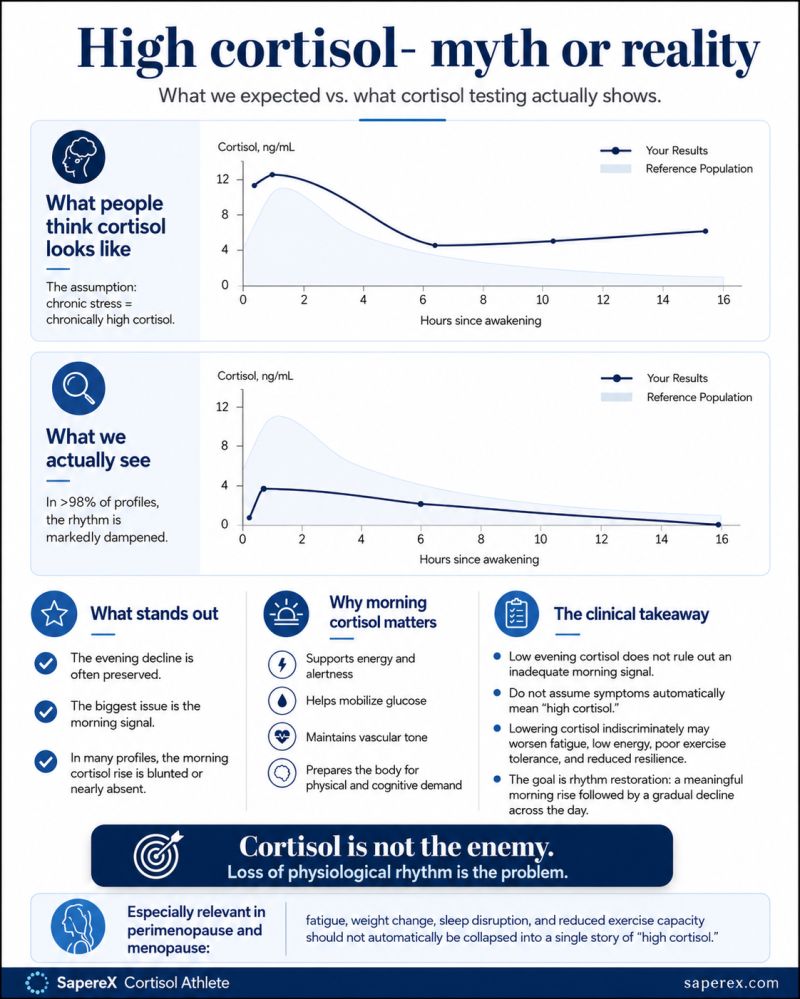
Most people's cortisol still declines appropriately in the evening. On that front, the wellness world has actually done its job: wind down, dim the lights, skip the late meal, let cortisol fall before bed.
The morning is where it breaks down. Profile after profile shows the same pattern: the normal morning rise — the one part of the curve that's supposed to be the strongest — is blunted, or almost entirely missing.
That distinction matters, because cortisol isn't a villain hormone to be lowered on sight. A healthy morning rise mobilizes energy, supports alertness, regulates glucose, maintains vascular tone, and prepares your body for the physical and cognitive demands of the day. Someone can have perfectly appropriate evening cortisol and still be running on an inadequate morning signal — two very different findings that get flattened into the same word: "high."
Which is exactly why so much of the advice aimed at fixing it may be making things worse. Lower your cortisol. Suppress it. Take this to block your stress response. The advice hits hardest at women in perimenopause and postmenopause, where weight change, fatigue, and low exercise tolerance get attributed to cortisol almost reflexively — and the fix offered is almost always the same: bring it down.
But if your morning signal is already blunted, suppressing it further doesn't fix fatigue. It deepens it.
The goal was never to eliminate cortisol. It's to restore its rhythm — a real rise in the morning, a real decline by night.
Three things worth sitting with
Low evening cortisol doesn't mean your morning signal is fine.
They're separate findings, often mistaken for the same problem.
"It feels like cortisol" isn't the same as measured cortisol.
Fatigue, weight change, and low energy have more than one possible cause — mine turned out to be iron, not stress hormones at all.
The fix isn't always "lower it."
For most people, the real issue is a rhythm that needs restoring, not a hormone that needs suppressing.
What this means for you
My 21 years didn't end because I finally found the right supplement or pushed through the right workout. They ended because someone finally measured instead of guessed — and because one of those measurements ruled cortisol out, which turned out to be just as important as any test that could have ruled it in.
That's the entire reason Your Cortisol Rhythm exists. I use real, expert-backed science — SapereX — to give you physiological facts about what your training and recovery are actually doing to your body. Not speculation. Not a story that sounds right because everyone else is telling it. Facts, measured, in context.
If your body has felt "off" in a way you can't quite explain — tired legs, flat energy, recovery that doesn't add up — the instinct to blame cortisol is understandable. It's also, statistically, probably wrong. The only way to know is to stop guessing and start measuring.
If this work gives even one runner a faster path to an answer than the 20 years it took me to find mine, it's done its job.
See What Your Own Rhythm Looks Like
SapereX Cortisol Athlete measures your pattern across a rest day and a training day, then interprets it against rest-day rhythm, training response, and recovery trajectory. Every test includes a free interpretation session with me — a $99 value, included.
Explore the TestDo not just get results. Know what to do next.
Book a one-on-one session and I'll walk you through exactly what your rhythm means and what to do next.
About Jay
I don't believe most people need more information. I believe they need more clarity. I created Your Cortisol Rhythm to help athletes understand what their bodies and their data are actually trying to tell them — so they can make better decisions in training, and in life. Because clarity changes everything.